
Catching Cancer Early: Liquid Biopsy and NGS at the Frontline of Detection
In oncology, timing is everything. Even with treatment improvements, many cancers are still being diagnosed too late for effective action. Early cancer diagnosis is a patient’s strongest weapon against cancer. Liquid biopsy transforms cancer diagnoses and strengthening targeted therapies towards the highest likelihood of clinical success. Advanced cellular and molecular methodologies stand at the frontline of this innovation. High-throughput Next Generation Sequencing (NGS) technologies powers liquid biopsy analysis by profiling cell-free DNA (cfDNA). Circulating tumour DNA (ctDNA), the tumour-derived fraction of cfDNA provides the most meaningful insights.
What if a simple blood test could pick up on cancer’s earliest molecular signals before the disease becomes apparent?
As next-generation sequencing (NGS) intersects with the study of circulating DNA, a significant shift in cancer biology is underway. At this crucial juncture, liquid biopsy is changing how we understand, detect and monitor cancer through sensitive, non-invasive genomic insights.
Looking back, why do traditional screenings fall short in early cancer detection?
Cancer remains a leading cause of death globally, and survival rates depend largely on how early the disease is detected.
While screening tools such as Pap smears and mammograms have improved early diagnosis for some cancers, they have limitations. Many cancers still lack reliable screening methods. Existing screening approaches often deliver low sensitivity, cause patient discomfort, and fail to address diverse tumour types.
Clinicians often catch cancer only after symptoms appear, usually at later stages when treatment choices are fewer and outcomes are poorer.
Traditional tissue biopsies are an essential diagnostic tool in oncology, their invasive nature and procedural demands can limit their suitability. Additionally, a single tissue sample may not capture tumour diversity and isn’t practical for long-term monitoring.
These limitations expose a critical gaps in early detection and disease tracking. They delay timely intervention and restrict continuous monitoring. To overcome these challenges, clinicians increasingly seek less invasive, more scalable diagnostic solutions.
Liquid Biopsy: Unlocking Early, Non‑Invasive Cancer Detection
NGS-based liquid biopsies provide a strong yet straightforward alternative to traditional diagnostics, allowing for non-invasive tumour profiling. Liquid biopsies uncover tumour-derived biomarkers in body fluids particularly circulating tumour DNA (ctDNA). This aids in early diagnosis, treatment monitoring, and post-therapy follow-up.
Among circulating substances such as circulating tumour cells (CTCs), cell-free DNA (cfDNA), and extracellular vesicles, cfDNA stands out as the most studied and useful biomarker. ctDNA (circulating tumour DNA) is a small part of total cell-free DNA released into the bloodstream during tumour cell death, with levels often linked to tumour burden and stage. Thanks to advancements in NGS sensitivity, ctDNA can now be detected at very low levels, enabling early mutation detection, monitoring of minimal residual disease, and insight into cancer long before it shows clinical signs.
This capability positions liquid biopsy as a vital tool at the forefront of precision oncology.
From Innovation to Impact: Liquid Biopsy in Real‑World Oncology
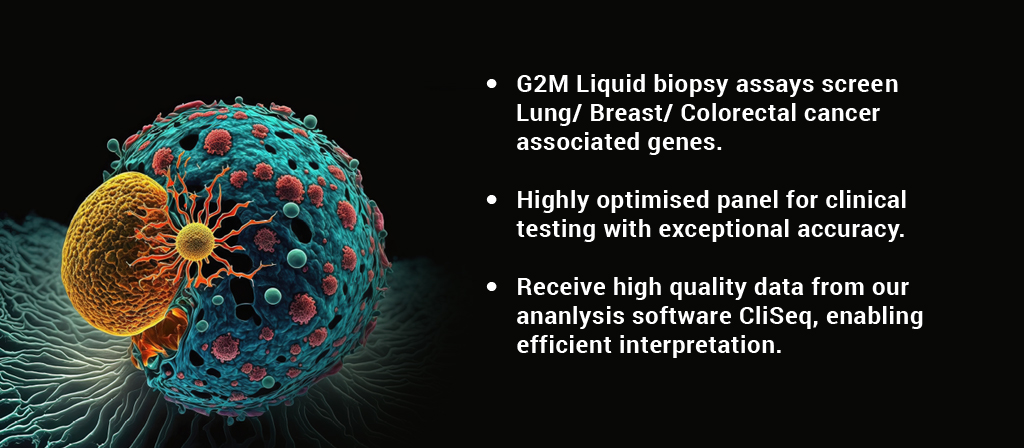
Translating these advances from the lab to the clinic requires assays that are not only sensitive, but also robust, scalable, and suited for real‑world samples— Genes2Me‘s Liquid Biopsy NGS panels bring this promise into clinical practice.
The G2M Liquid Biopsy Assay provides targeted, high-performance NGS panels for lung, breast, and colorectal cancers. It is designed for reliable detection from very low amounts of cfDNA (10–20 ng). With ultra-deep sequencing strategies and assay design, it enables sensitive and reproducible detection of clinically important variants, even at very low allele frequencies.
Genes2Me is accelerating the transition of liquid biopsy–powered NGS from an emerging innovation to a much-needed tool for early, personalised cancer care.
