
A Healthy Start Begins with a Few Drops
Most newborns look healthy at birth. A small number, though, carry a metabolic or genetic disorder that shows no symptoms in the first weeks while it quietly harms the brain, liver, or other organs.
Many of these disorders can be treated if they are found early, and newborn screening is how they are found. All it takes is a few drops of blood from the baby’s heel, collected in the first days of life.
In this post, we explain what newborn screening involves, why it matters in India, and how the G2M Newborn Screening NGS Kit helps laboratories add genetic screening to their services.
What Is Newborn Screening?
Newborn screening (NBS) checks babies for serious hormonal, metabolic, and genetic disorders, ideally 24 to 72 hours after birth. A nurse pricks the baby’s heel and blots a few drops of blood onto a filter-paper card, called a dried blood spot (DBS), which goes to a laboratory for testing.
A typical screening panel looks for:
- Congenital hypothyroidism, which can cause intellectual disability if untreated
- G6PD deficiency, which can lead to severe anaemia and jaundice
- Phenylketonuria (PKU) and other inborn errors of metabolism
- Congenital adrenal hyperplasia, which can be life-threatening within weeks
- Galactosemia and biotinidase deficiency
- Haemoglobin disorders such as thalassaemia and sickle cell disease
A positive screen is not a diagnosis. It tells doctors which babies need confirmatory tests.
Why It Matters in India
Around 25 million babies are born in India every year, more than in any other country. High genetic diversity, along with consanguineous marriage in some communities, raises the risk of inherited disorders.
Screening has not kept pace. Expanded newborn screening is still patchy; many parents have never heard of it, and many babies are tested for only one or two conditions, or none at all.
That gap matters because treatment is often simple: a daily thyroid tablet, a special diet, or avoiding certain medicines. Caught early, many of these disorders become manageable conditions instead of lifelong disabilities.
Going Beyond Biochemistry
Standard screening measures biochemical markers in the blood. It works well, but it covers a limited list of disorders, some markers shift with feeding or prematurity, and false positives lead to worry and repeat tests.
Genomic newborn screening uses next-generation sequencing (NGS) to read the baby’s DNA from the same dried blood spot. A single sequencing run examines hundreds of genes at once.
Used alongside biochemical screening, it helps doctors:
- Detect disorders that have no reliable biochemical marker
- Confirm or rule out abnormal biochemical results sooner
- Pinpoint the genetic cause, which guides treatment and family counselling
The G2M Newborn Screening NGS Kit
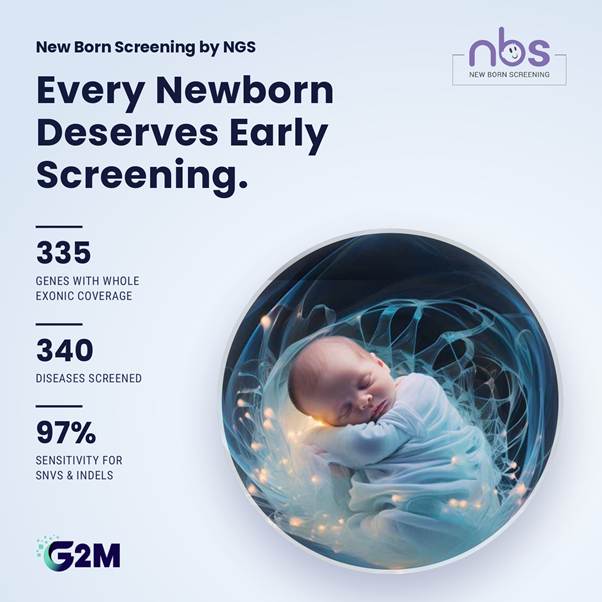
The G2M Newborn Screening NGS Kit is developed and manufactured in India. It screens 335 genes linked to 340 diseases from a single sample, far beyond the scope of standard newborn testing.
Key features
| Feature | Details |
| Coverage | Whole exonic regions of 335 genes linked to 340 diseases (~1.5 Mb target) |
| Chemistry | Hybridization capture-based target enrichment for high specificity and uniform coverage |
| Sample | Dried blood spot from a heel prick (5 punches of 3.2 mm) or 1 ml of peripheral blood |
| Sequencers | Compatible with Illumina, MGI, Element Biosciences (AVITI) and Thermo Fisher platforms |
| Library preparation | Manual, or automated on G2M’s EZY AutoPrep-48 workstation |
| Reporting | CliSeq Interpreter software, cloud-based or on a local server, produces ACMG-based reports of clinically significant mutations |
Panel performance
| Coverage uniformity | Sensitivity | Reproducibility | On-target ratio |
| 97% | 97% | 96.1% | >78% |
Disorders covered
- Metabolic disorders: amino acid, organic acid and fatty acid β-oxidation disorders; carbohydrate and endocrine disorders; metabolic epilepsies; and other inborn errors of metabolism
- Genetic disorders: hereditary deafness, β-thalassaemia, haemophilia B, Noonan syndrome, Marfan syndrome and others
What the report shows
Each report lists every clinically significant variant found, with its gene, zygosity, associated disease, inheritance pattern and ACMG classification, followed by an interpretation and recommended next steps.
In one sample report, a 22-day-old baby tested for deafness was found to carry a pathogenic homozygous variant in the GJB2 gene. A clear answer like this lets the family start hearing support early.
Every Baby Deserves to Be Screened
Newborn screening is one of the simplest ways to protect a child’s future. A few drops of blood today can prevent years of illness later.
This Newborn Screening Awareness season, we encourage parents to ask their doctor about screening before leaving the hospital, and laboratories and hospitals to make genomic screening available to the families they serve.
