
Detect, Differentiate, Quantify: A Complete Approach to BCR-ABL Testing
Cancer is one of the leading health challenges worldwide. Among the many forms of cancer, leukemia remains one of the most complex diseases to diagnose and manage. Unlike solid tumors, leukemia affects the blood and bone marrow, disrupting the body’s ability to produce healthy blood cells. Over the years, advances in molecular diagnostics have transformed leukemia care. Molecular diagnostics enables clinicians to detect disease-causing genetic abnormalities with remarkable precision. One such breakthrough discovery is the BCR-ABL fusion gene. It is a biomarker that has revolutionized the diagnosis, monitoring, and treatment of certain leukemias.
What is the BCR-ABL Fusion Gene?
The BCR-ABL fusion gene is formed due to a genetic rearrangement known as a chromosomal translocation. Specifically, parts of chromosome 9 and chromosome 22 exchange genetic material, creating an abnormal chromosome called the Philadelphia chromosome. During this process, the BCR gene from chromosome 22 fuses with the ABL1 gene from chromosome 9.
BCR-ABL fusion gene produces an abnormal protein called BCR-ABL tyrosine kinase. In normal condition, cellular proteins regulate cell growth in a controlled manner. But this abnormal protein continuously signals cells to divide and multiply. As a result, abnormal white blood cells accumulate in the bone marrow and bloodstream, eventually leading to leukemia.
How is BCR-ABL Related to Leukemia?
The BCR-ABL fusion gene is considered the molecular hallmark of Chronic Myelogenous Leukemia (CML). This translocation is detected in >90% of patients with Chronic Myelogenous Leukemia (CML). And ~20% of Acute Lymphoblastic Leukemia (ALL) patients, which predominantly express the p210 and p190 proteins, respectively. Although rare, occasional reports have identified BCR-ABL in certain Acute Myeloid Leukemia (AML) cases.
BCR-ABL fusion gene not only confirms the diagnosis but also provides critical information regarding disease prognosis and treatment selection.
Why is BCR-ABL Testing So Important?
Historically, leukemia diagnosis relied heavily on microscopic examination of blood and bone marrow samples. While these methods remain important, they cannot provide the molecular-level insights required for precision medicine.
BCR-ABL testing enables clinicians to confirm the diagnosis of CML and certain ALL cases, identify specific transcript variants, establish baseline disease burden and monitor treatment response. It also help to detect minimal residual disease (MRD) and identify disease progression or relapse at an early stage.
To support these evolving clinical needs, laboratories require diagnostic solutions that combine accuracy, sensitivity, and workflow efficiency.
Comprehensive Detection When It Matters Most
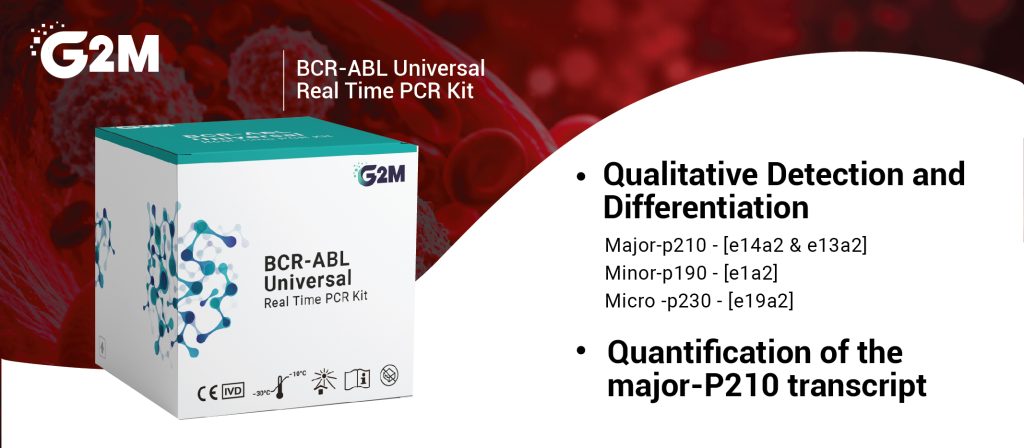
The Genes2Me BCR-ABL Universal Real-Time PCR Kit is to provide a complete molecular picture from the very first test. The kit helps in qualitative detection and differentiation of clinically relevant Major (p210), Minor (p190), and Micro (p230) fusion transcripts. Additionally, it enables precise quantification of Major (p210) transcripts for disease burden evaluation and longitudinal monitoring.
The kit converts extracted RNA into cDNA and amplifies it using a one-step qRT-PCR workflow for precise transcript detection and quantification. And uses highly specific primers and fluorescent probes to detect major, minor, and micro fusion transcripts in separate reactions. Fluorescent reporter dyes enable accurate amplification monitoring. It includes a complete set of quantification standards (QS1–QS5) to generate standard curves for reliable quantification of BCR-ABL1 transcript levels.
By integrating diagnosis and monitoring capabilities within a single workflow, the Universal Kit helps laboratories to generate clinically meaningful results.
Precision Monitoring for Long-Term Disease Management
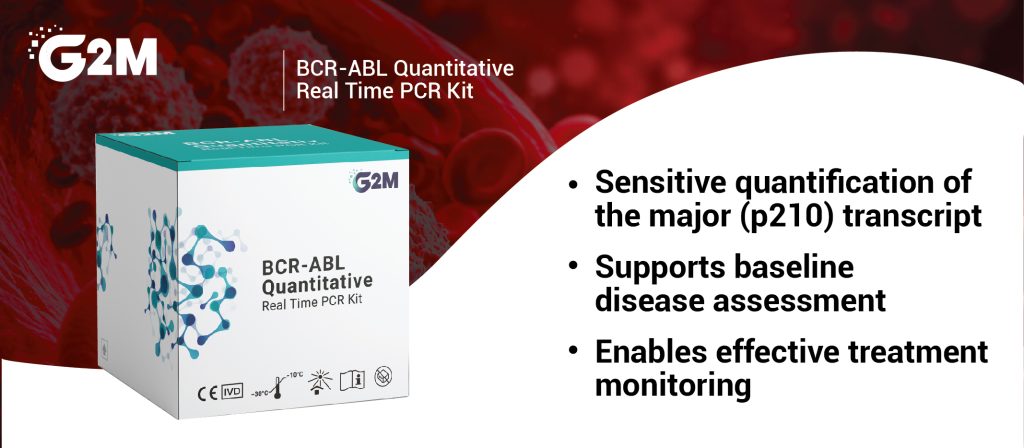
As treatment progresses, accurate quantification becomes increasingly important. The Genes2Me BCR-ABL Quantitative Real-Time PCR Kit is specifically designed for sensitive and reliable quantification of Major (p210) BCR-ABL1 transcripts. Quantification standards and ABL1-based normalization supports precise measurement of transcript levels, enabling effective treatment monitoring and minimal residual disease assessment.
Hence, Its robust assay design delivers reproducible results that help clinicians evaluate therapeutic response throughout the patient’s treatment journey.
Built for Confidence, Designed for Clinical Excellence
Additionally, Both kits incorporate the ABL1 gene as an internal control, ensuring assay integrity and result reliability. Developed on advanced RT- PCR technology and validated across widely used PCR platforms, these solutions offer the sensitivity, specificity, and consistency required for modern oncology laboratories.
Driving the Future of Personalized Leukemia Care
In the era of precision medicine, molecular insights are increasingly shaping treatment strategies. From initial diagnosis and transcript characterization to long-term response monitoring, Genes2Me‘s BCR-ABL testing portfolio empowers laboratories with the tools needed to deliver actionable clinical information.
Because in leukemia management, every result matters, and every molecular insight brings healthcare one step closer to truly personalized oncology care.
