
Behind every Lung cancer is a molecular driver. Are we looking for it? – The genome shows what. The right test shows how.
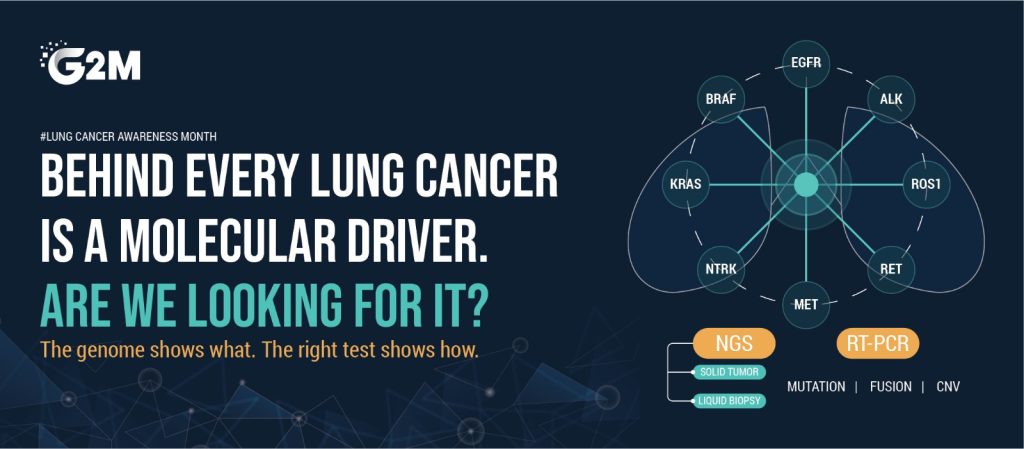
The case for awareness is clear. Lung cancer is common, deadly and too often found late, and patients who look identical on a scan can be driven by entirely different molecular alterations. This blog asks the next question: what kind of awareness do we need, and what should we know about lung cancer at the molecular level?
Our answer is that awareness has to go beyond symptoms and risk factors. It has to include three ideas: a lung tumour has a molecular identity, that identity can be tested, and how reliably it is tested decides what is found.
Three Ways to Read a Tumour
Once we accept that every tumour has a molecular identity, the practical question is how to read it. Three approaches dominate lung cancer testing today, and each answers a different kind of question.
| Method | What it reads | Where it is strongest | The trade-off |
| Real-time PCR (RT-PCR) | Specific, predefined variants and known fusions | Speed, sensitivity on known hotspots, low sample input, and a simple workflow on widely available instruments | It only finds what it was designed to look for, so rarer variants and unusual fusion partners can be missed |
| Tissue NGS (DNA and RNA) | Many genes at once: variants, copy number changes and TMB from DNA, plus fusions and splice events from RNA | Breadth in a single run, including rare and unexpected alterations, from one precious sample | Needs adequate sample quality and quantity, and a longer workflow with bioinformatics |
| Liquid biopsy (ctDNA NGS) | Tumour-derived DNA circulating in blood plasma | Patients whose tissue is insufficient or whose biopsy is risky, and repeat sampling over time | Sensitivity depends on how much DNA the tumour sheds |
These methods are not rivals. A fast PCR result can answer the most urgent question quickly, sequencing can complete the picture, and a blood test can reach patients and moments where tissue cannot. Choosing among them is a decision about the sample, the question and the time available.
Where Molecular Testing Falls Short
A molecular result is only useful if it is complete, accurate and timely. In practice, four problems come up repeatedly.
- Small samples. Many lung cancers are diagnosed on small biopsies or cytology specimens, leaving limited DNA and RNA to work with.
- Exhausted tissue. Running single-gene tests one after another can use up the sample before every relevant target has been checked, which is why guidelines favour broad, multi-gene testing where it is feasible.
- Missed fusions. DNA-only assays can fail to capture rearrangements with variable breakpoints, so a negative result may not be a true negative.
- Low-shedding tumours. When tissue is unavailable, circulating tumour DNA (ctDNA) from a blood sample is a valuable alternative. A positive plasma result is highly informative, but a negative one cannot always rule an alteration out, because some tumours release very little DNA.
These gaps are not reasons to hold back from testing. They are reasons to choose the method, and the test, with care.
What Reliable Detection Looks Like
When evaluating an assay for lung cancer, a few performance characteristics matter more than a long gene list.
| Metric | What it tells you | Why it matters on real samples |
| Sensitivity and limit of detection | The lowest variant allele frequency reliably detected | Low-frequency variants in tissue and plasma are easy to miss |
| Reproducibility | Whether repeat runs give the same call | Results must hold up across runs, operators and batches |
| Coverage uniformity and depth | How evenly and deeply each target is read | Uneven coverage leaves blind spots in clinically relevant regions |
| Input requirement | DNA or RNA quantity needed | Small biopsies and low-yield cfDNA leave little material |
| Sample compatibility | FFPE, fresh tissue, plasma | Degraded or limited specimens are routine in lung cancer |
| Turnaround time | Time from sample to result | Treatment decisions should not wait on a slow workflow |
| Analysis and reporting | Variant calling, annotation, interpretation | A raw variant list is not a clinical report |
As testing matures, repeat sampling matters too. Serial ctDNA analysis can track how a tumour’s molecular profile changes over time, which makes consistent, reproducible performance even more important.
Where Genes2Me Fits In
Knowing what to ask of a test only helps if there are tests that answer well, and that is the thinking behind our lung cancer portfolio. For comprehensive tissue profiling, the FOCUS Lung NGS Assay covers 73 DNA genes and 18 RNA fusion genes from FFPE or fresh tissue, detecting SNVs, indels, CNVs, fusions, TMB and MET exon 14 skipping, with a sensitivity of 98.5%, reproducibility of 97.4%, coverage uniformity above 99% and a workflow of about 1.5 days. When tissue is limited, the ctDNA Lung panel in our liquid biopsy portfolio profiles 32 genes from just 10 to 20 ng of cell-free DNA at a recommended depth of 25,000X, with a reported sensitivity and reproducibility of 96% on the Illumina platform, supported by our automated Rapi-X LB extraction. For fast, focused answers on the most common drivers, our CE-IVD oncology RT-PCR kits, including EGFR-Q, KRAS-Q, BRAF-Q and EML4-ALK, run on widely used real-time PCR instruments and show no cross-reactivity with non-target oncogenic variants. Both NGS workflows work across multiple sequencing platforms and with our CliSeq Interpreter for analysis and reporting, so RT-PCR for speed, NGS for breadth and liquid biopsy for hard-to-reach tumours give laboratories a complete route from sample to a result that clinicians can act on.
The Takeaway
The scan shows where the tumour is, the slide shows what it looks like, and the genome shows what is driving it. This November, the question worth asking for every patient with advanced lung cancer is whether the tumour has been tested comprehensively, on the right sample, with the right method.
