
From HLA-B27 to HLA Typing: Molecular Insights into Inflammatory Diseases
The Clinical Challenge
Arjun is 28. He writes code for a living, plays cricket on weekends, and for almost a year, every morning has started the same way: stiff. His lower back feels locked when he wakes up, and it only eases after he has been moving around for a while. He blamed his chair, then his mattress, then his long hours at the laptop.
But some things didn’t fit. Rest made the pain worse, and movement made it better. Last winter he also had a painful red eye that his doctor called uveitis. That pattern is what makes a clinician stop and ask whether this is inflammation rather than ordinary back strain.
Arthritis is not one disease. It is a large family of conditions, some driven by wear and tear, some by inflammation, and some by the immune system turning on the body’s own tissues. Telling them apart usually takes several things together: a clinical evaluation, laboratory tests and imaging. Arjun’s symptoms point towards the spondyloarthropathies, a group of inflammatory conditions that affect the spine and sacroiliac joints. In these conditions, genetics can add a useful clue.
Understanding HLA and Its Role in Immune Function
Imagine every cell in your body wearing an ID badge that tells the immune system what is happening inside it. Those badges are made by the human leukocyte antigen (HLA) genes. HLA proteins present small protein fragments to immune cells, helping the body tell “self” from “non-self” and decide when to respond.
HLA genes are among the most variable in the human genome, and certain variants are linked with particular diseases. Even so, an association is not a diagnosis: many people carry disease-associated HLA variants and never develop the condition.
HLA-B27: A Key Genetic Marker in Spondyloarthritis
One variant stands out in rheumatology: HLA-B27. It is one of the best-established genetic markers of axial spondyloarthritis (axSpA), a chronic inflammatory condition that mainly affects the spine and sacroiliac joints. Ankylosing spondylitis is the form of axSpA in which changes are visible on X-ray.
HLA-B27 testing is recommended when axSpA is suspected, especially in people with:
- Persistent back pain that began before the age of 45
- Back pain with inflammatory features, such as morning stiffness that improves with movement
- A history of uveitis, psoriasis or inflammatory bowel disease
- Other clinical findings suggestive of spondyloarthritis
Arjun matches the list almost line by line. Still, a positive result does not confirm the disease on its own, and a negative result does not rule it out. HLA-B27 is a clue, not a verdict.
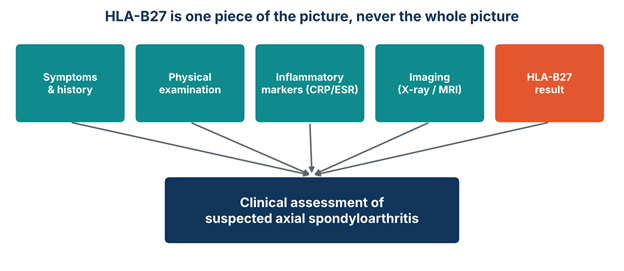
Figure 1. HLA-B27 adds weight to the clinical picture; it is interpreted alongside symptoms, examination, blood markers and imaging.
HLA-B27 Testing with Real-Time PCR: Introducing G2M’s HLA B27-Q Kit
So how does the lab answer the question, “Is HLA-B27 present?” Real-Time PCR amplifies a specific DNA sequence and tracks a fluorescent signal as it does. That makes it fast and targeted, which is ideal for a focused question.
The G2M HLA-B27-Q Real-Time PCR Kit is a qualitative in vitro diagnostic (IVD) assay that detects the HLA-B27 allele in human clinical samples, including whole blood. Its multiplex design pairs specific primers and fluorescent probes with an internal control that monitors every reaction. The kit is intended for use by appropriately trained, semi-skilled laboratory professionals.
Beyond a Single Marker: What Is HLA Typing?
Arjun’s question was narrow. Many questions in immunogenetics are broader: exactly which HLA alleles does a person carry, across many HLA genes, at high resolution? That is what HLA typing answers. It has established roles in transplant compatibility assessment and immunogenetic research, including studies of how HLA variation relates to inflammatory disease. It is not, however, a universal diagnostic test for arthritis. Its value depends on the loci analysed and the question being asked.
HLA Typing Through NGS: The G2M HLA Typing NGS Panel
Next-generation sequencing (NGS) reads many DNA regions in parallel, which suits the HLA region, the most densely polymorphic part of the genome. The Genes2Me HLA Typing NGS Panel delivers high-resolution, phase-resolved results: it shows not only which variants are present but which ones sit together on the same copy of a gene. The result is unambiguous typing that supports confident donor selection in transplantation.
- 11 loci in one tube: Class I (HLA-A, B, C) and Class II (DPA1, DPB1, DQA1, DQB1, DRB1, DRB3, DRB4, DRB5)
- Whole coding sequence, a target size of about 71 kb, from blood samples
- Hybridisation capture enrichment, which improves sensitivity and reduces PCR bias such as allele drop-outs
- Platform-agnostic libraries (200–700 bp) and an end-to-end CE-IVD workflow, from extraction to reporting
- Validated performance (Illumina platform): 100% sensitivity, 99% reproducibility, 98% coverage uniformity and an 85% on-target ratio
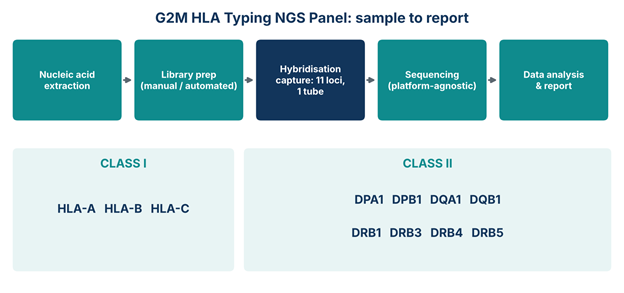
Figure 2. The G2M HLA Typing NGS workflow and the 11 HLA loci it covers.
Real-Time PCR and NGS: Different Approaches, Distinct Objectives
These technologies are not competitors, and not every patient needs both. Real-Time PCR gives targeted detection of a single marker; NGS characterises many HLA loci in depth. They are complementary, and the right choice depends on the clinical or research question.
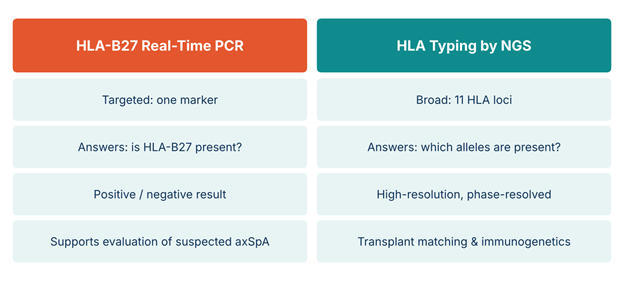
Figure 4. Choosing the right tool for the right question.
Integrating Molecular Results into Clinical Assessment
Arjun’s HLA-B27 result came back positive. On its own, it didn’t diagnose him. What it did was add weight to everything else his rheumatologist saw: early onset, inflammatory back pain, a history of uveitis, raised inflammatory markers and findings on MRI. Together, the picture was clear enough to start treatment aimed at the inflammation, not at his chair. Had the result been negative, his doctor would have kept looking.
That is the real lesson: a genetic result is most powerful when it is interpreted, not just reported.
Conclusion
Molecular diagnostics add valuable genetic insight to the assessment of selected inflammatory conditions. Targeted HLA-B27 detection by Real-Time PCR and high-resolution HLA typing by NGS each serve a distinct purpose. At G2M, we continue to advance molecular diagnostics with solutions for both, so that labs and clinicians can choose the right tool for every patient’s story.
Arjun is an illustrative composite, not a real patient. This article is for general information and is not medical advice.
