
Sepsis & AMR: A Growing and Compounding Clinical Challenge -Why Faster Detection Matters
If you had to guess how many people die from sepsis each year, what would you say? A few hundred thousand? A million?
The global burden is far greater.
According to the World Health Organization (WHO), an estimated 48.9 million cases of sepsis and 11 million sepsis-related deaths occurred globally in 2017, representing approximately 20% of all global deaths. WHO continues to cite these figures as the available global estimates, while also noting that reliable population-level sepsis data remain challenging to collect.
The burden is particularly high in low- and middle-income countries, where resources for the prevention, diagnosis and treatment of sepsis can be more limited. Moreover, the challenge becomes even more complex when antimicrobial resistance (AMR) enters the picture.
What Exactly Is Sepsis?
Sepsis is a life-threatening condition in which the body’s dysregulated response to an infection causes injury to its own tissues and organs. It can result from infections originating in the lungs, urinary tract, bloodstream or other sites.
Without early recognition and appropriate treatment, sepsis can progress to organ dysfunction, septic shock and death. The risk is particularly high among newborns, older adults, pregnant women and people with underlying conditions.
WHO estimates that approximately 20 million sepsis cases occurred in children under 5, based on 2017 global estimates.
Sepsis is not simply an infection; it is a rapidly evolving clinical emergency where early recognition and timely treatment matter.
A Second Crisis Making the First One More Difficult
As if sepsis alone were not enough of a challenge, antimicrobial resistance is making the treatment of serious bacterial infections increasingly complex.
Antimicrobial resistance occurs when microorganisms no longer respond to antimicrobial medicines. As a result, infections can become difficult or impossible to treat, increasing the risk of severe illness, complications and death.
The latest global surveillance data show just how widespread the problem has become. According to WHO’s Global Antibiotic Resistance Surveillance Report 2025, approximately 1 in 6 laboratory-confirmed bacterial infections causing common infections worldwide were resistant to antibiotics in 2023.
WHO also reported that between 2018 and 2023, antibiotic resistance increased in more than 40% of the pathogen–antibiotic combinations monitored, with an average annual increase of approximately 5–15% among the combinations where resistance increased.
The global burden is also reflected in mortality. In 2021, bacterial AMR was estimated to be associated with approximately 4.71 million deaths worldwide, including 1.14 million deaths directly attributable to bacterial AMR.
When AMR Meets Bloodstream Infections
Antimicrobial resistance becomes particularly challenging when it affects serious bloodstream infections.
WHO’s latest surveillance data identify Escherichia coli and Klebsiella pneumoniae among the leading drug-resistant Gram-negative bacteria found in bloodstream infections. Globally, >40% of E. coli and >55% of K. pneumoniae were resistant to third-generation cephalosporins.
When resistant pathogens are involved, treatment can become more difficult and options more limited — making timely information about the pathogen and relevant resistance mechanisms increasingly important.
Why Every Hour Matters
In sepsis, time is critical. Early recognition and appropriate antimicrobial treatment are central to effective management.
Traditional bloodstream infection diagnosis commonly relies on blood culture followed by organism identification and antimicrobial susceptibility testing (AST). While culture remains an important diagnostic method, it requires microbial growth before subsequent testing can provide additional information.
This creates a diagnostic gap:
The patient needs relevant information now. The conventional workflow may take considerably longer.
From “What Is Causing the Infection?” to “What Can We Do About It?”
Identifying the pathogen is only part of the diagnostic question.
Understanding whether relevant antimicrobial resistance genes are also present can provide an additional layer of molecular insight.
This is where molecular diagnostics can help.
Rapid molecular assays can simultaneously detect targeted pathogens and resistance determinants, providing a more consolidated molecular picture in a shorter timeframe than conventional culture-dependent workflows.
The goal is simple:
Detect the pathogen. Identify relevant resistance. Get molecular insights faster.
Introducing SepsiAMR-Q: Bringing Sepsis and AMR Detection Together
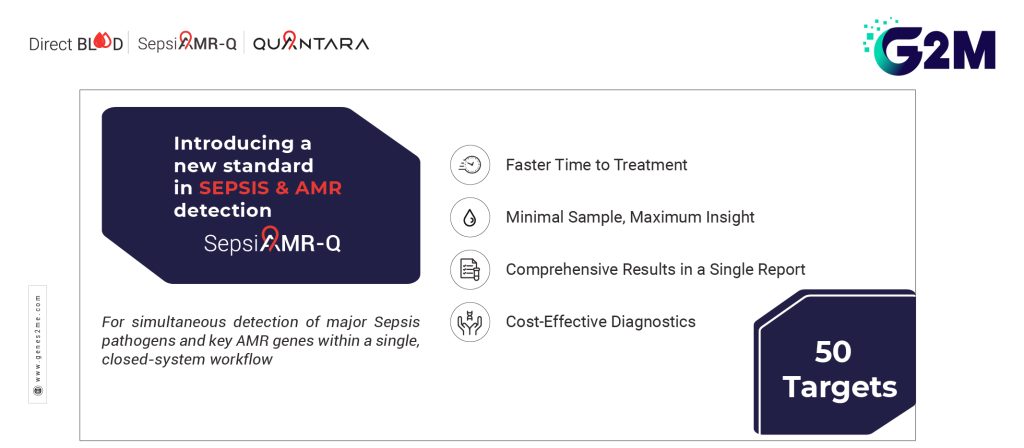
To address this diagnostic need, G2M has developed SepsiAMR-Q, a multiplex real-time PCR assay designed for the simultaneous detection of key sepsis-associated pathogens and antimicrobial resistance genes.
Rather than approaching pathogen identification and AMR detection as separate testing questions, SepsiAMR-Q brings them together within a single molecular assay.
The assay is designed to provide detection across:
- Gram-positive pathogens
- Gram-negative pathogens
- Fungal targets relevant to bloodstream infections
- Antimicrobial resistance genes
SepsiAMR-Q enables the simultaneous detection of 32 sepsis-associated pathogens and 18 AMR genes, bringing 50+ targets together within a consolidated multiplex molecular testing approach.
The assay is designed for direct detection from whole blood as well as blood culture samples, with the direct-whole-blood workflow eliminating the need for a culture step.
According to current product material, results can be obtained in approximately 2.5 hours directly from whole blood, without the need for culture. That difference matters.
Instead of waiting for microbial growth before molecular testing can begin, direct-from-whole-blood testing is designed to bring molecular information closer to the point at which the clinical question arises.
Direct From Whole Blood: Closing the Diagnostic Time Gap
Whole Blood → Rapi-X16™ Extraction → Molecular Detection → Pathogen + AMR Information
The workflow brings together the Rapi-X16™ automated extraction platform and QUANTARA, G2M’s PCR amplification platform, to support an integrated molecular testing workflow from nucleic acid extraction through amplification and reporting.
By combining automated extraction with multiplex molecular detection, SepsiAMR-Q provides multiple molecular insights from a single sample while helping streamline the testing workflow.
From Molecular Detection to Clinical Insight
Sepsis rarely presents a single straightforward question. Clinicians may need to understand:
What pathogen is present? Is antimicrobial resistance involved? What molecular information can support the next clinical decision?
SepsiAMR-Q is designed to address these questions within a single multiplex molecular testing approach.
By combining pathogen and AMR detection, the assay can provide a consolidated molecular view of targeted pathogens and resistance determinants within a single report, helping reduce the need to approach these targets through multiple sequential molecular tests.
The product workflow is also designed around minimal sample requirements and consolidated reporting.
Powering Rapid Molecular Detection with QUANTARA
Behind every molecular diagnostic solution is the need for a reliable amplification platform.
Introducing QUANTARA — G2M’s PCR amplification platform designed to support automated report generation.
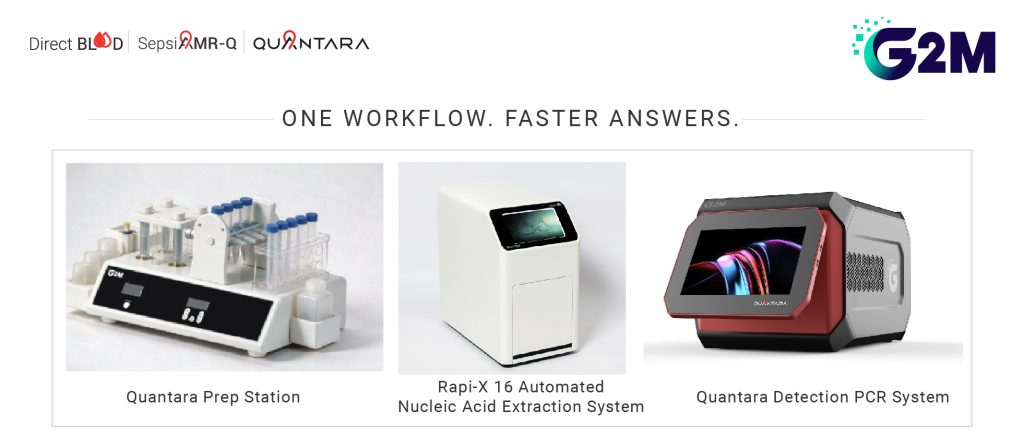
QUANTARA provides the amplification platform for the SepsiAMR-Q assay, bringing together the assay’s multiplex molecular detection capabilities with an instrument designed to support streamlined result generation.
Together, SepsiAMR-Q and QUANTARA create a molecular testing solution built around one central principle:
Get more diagnostic information, in less time.
The combination brings pathogen and AMR detection into a consolidated molecular workflow while supporting automated report generation and a streamlined testing experience.
Why This Matters for Sepsis Care
Faster molecular information does not replace clinical judgment, culture, or antimicrobial susceptibility testing (AST) where clinically required. Instead, it can provide additional information earlier in the diagnostic journey.
For sepsis and AMR, this can mean:
- Faster Molecular Insight: Earlier information on targeted pathogens and resistance determinants.
- Multiple Insights, One Test: Pathogen and AMR detection from a single testing approach.
- Consolidated Results: A more integrated molecular picture of the infection and relevant resistance.
- Supporting Stewardship: Earlier molecular information can complement antimicrobial decision-making, while phenotypic AST remains essential where clinically required.
With SepsiAMR-Q + QUANTARA, G2M brings pathogen and AMR detection into a streamlined molecular workflow.
From Reactive to More Informed Sepsis Management
Sepsis care is a race against time. Beyond identifying an infection, clinicians need timely information about the pathogen involved and relevant resistance mechanisms.
WHO’s latest AMR surveillance data show that approximately 1 in 6 laboratory-confirmed bacterial infections causing common infections worldwide were resistant to antibiotics in 2023. For bloodstream infections, high levels of third-generation cephalosporin resistance in E. coli and K. pneumoniae further highlight the need for timely pathogen and AMR information.
With SepsiAMR-Q, G2M brings targeted pathogen and AMR detection together in a single multiplex RT-PCR assay, supported by QUANTARA for PCR amplification and automated report generation.
When every hour matters, more information in less time can make a difference.
This World Sepsis Day, Let’s Talk About the Time Between Infection and Insight.
Sepsis remains a major global health challenge, while antimicrobial resistance is adding complexity to the diagnosis and treatment of serious bacterial infections.
The latest WHO data show that the challenge is not static.
Approximately 1 in 6 laboratory-confirmed bacterial infections causing common infections were resistant to antibiotics in 2023, while bacterial AMR was associated with an estimated 4.71 million deaths in 2021.
At the same time, WHO continues to cite an estimated 48.9 million sepsis cases and 11 million sepsis-related deaths globally, based on 2017 estimates.
Awareness is an essential first step — but awareness must be accompanied by early recognition, timely treatment, appropriate antimicrobial use, effective infection prevention and control, and better access to diagnostic information.
As molecular diagnostics continue to evolve, the opportunity is to shorten the distance between infection, identification and informed clinical action.
This World Sepsis Day, the message is clear:
Recognize sooner. Detect more. Act with better information.
With SepsiAMR-Q, G2M brings targeted pathogen and AMR detection together in a single multiplex RT-PCR assay, supported by an integrated workflow incorporating Rapi-X16™ and QUANTARA.
Molecular detection for a faster, more informed approach to Sepsis & AMR.
