
From Early Detection to Deeper Understanding: The Changing Landscape of Blood Cancer
Blood cancer is more than a diagnosis. But how much do we really know about what lies beneath it?
Recognizing the signs and seeking timely medical attention are important first steps. But as our understanding of blood cancer continues to evolve, advances in molecular diagnostics are helping us look beyond the initial diagnosis and explore the disease in greater detail.
This Blood Cancer Awareness Month, let’s take a closer look at the signs, the diagnostic journey, and how molecular testing is adding greater insight into blood cancers.
Blood cancer is not a single disease. It is a broad group of cancers affecting the blood, bone marrow, lymphatic system, or the cellular components of these tissues. Leukemias, lymphomas, and multiple myeloma are among the major types, each with its own biological characteristics, disease course, and diagnostic considerations.
But even though awareness starts from understanding the disease itself, that’s not where it ends.
This is because understanding what lies beneath the surface in the case of blood cancer matters.
Knowing the Signs Matters
There are different types of blood cancers, each with unique symptoms that can sometimes overlap with those of other diseases.
Depending on the type of blood cancer, possible signs may include:
- Persistent or unexplained fatigue
- Frequent or recurrent infections
- Unexplained fever
- Easy bruising or unusual bleeding
- Unexplained weight loss
- Swollen lymph nodes
- Persistent bone or joint pain
- Night sweats
Having one or more of these symptoms does not necessarily mean that a person has blood cancer. However, persistent, unusual, or unexplained symptoms should not be ignored.
Awareness is not about assuming the worst. It is about knowing when to look closer.
From Awareness to Diagnosis
Recognizing a warning sign is only the beginning. A blood cancer diagnosis often involves multiple layers of investigation rather than a single test.
Depending on the suspected type of blood cancer, doctors may use several different tests to build a clearer picture. These can include a clinical evaluation, blood counts, examination of blood or bone marrow, immunophenotyping, cytogenetic testing, and molecular testing. Each test looks at the disease from a different angle, helping clinicians understand what is happening and arrive at a more informed diagnosis.
This is especially important because blood cancers can be complex, and the same type of cancer may not look or behave exactly the same way in every patient. Two people with similar symptoms or clinical findings can have very different disease biology, which is why looking beyond the initial presentation can make a meaningful difference.
This is where the evolution of diagnostic science becomes particularly important.
Looking Beyond the Cells
Cancer is fundamentally a disease driven by changes in cells and their genetic machinery.
In blood cancers, specific genetic alterations can be associated with particular disease subtypes, prognosis, disease biology, or therapeutic considerations. Identifying these changes can therefore provide deeper understanding of the disease and reveal information that may not be apparent through routine tests or examination alone.
Molecular diagnostics allows us to look deeper — from identifying specific genetic alterations to building a broader picture of the disease at the molecular level.
Technologies such as real-time PCR and next-generation sequencing (NGS) have become important tools in this evolving diagnostic landscape.
While real-time PCR can enable targeted detection of specific molecular alterations, NGS can assess multiple genes and genomic regions in a single assay. Together, these technologies can support different diagnostic needs across the spectrum of hematological malignancies.
Why Early and Accurate Diagnosis Matters
The journey from symptoms to diagnosis can be filled with uncertainty. Timely and appropriate testing can help reduce that uncertainty by providing clinicians with information needed to characterize the disease more effectively.
For many blood cancers, the earlier the disease is identified and the more precisely it can be characterized, the better positioned healthcare professionals may be to make informed clinical decisions.
This does not mean that molecular testing replaces clinical assessment or other diagnostic methods. Rather, it adds another layer of information, one that can help reveal the biology of the disease and complement the broader diagnostic picture.
Additionally, as precision medicine continues to evolve, that additional layer of information is becoming increasingly valuable.
Supporting Blood Cancer Diagnostics with Molecular Solutions
At Genes2Me, we believe that better cancer diagnosis starts with a better understanding of the disease. By making molecular testing more accessible to laboratories and healthcare professionals, we aim to help bring deeper insights into cancer biology closer to clinical practice.
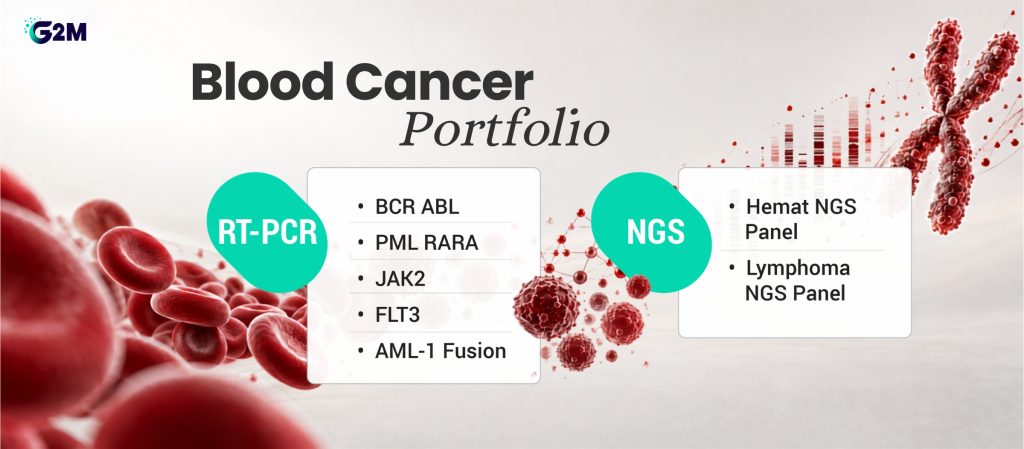
Our portfolio brings together both NGS-based and targeted RT-PCR solutions to support molecular testing across hematological malignancies.
Comprehensive Molecular Profiling with NGS
Our Hemat NGS Panel and Lymphoma NGS Panel support broader genomic profiling of hematological malignancies, enabling the assessment of multiple relevant genetic alterations within a single NGS workflow.
By bringing broader molecular information into the diagnostic workflow, these solutions can help provide a more comprehensive view of disease biology.
Targeted Molecular Testing with RT-PCR
When specific molecular alterations need to be investigated, targeted RT-PCR can complement the broader diagnostic workup. Genes2Me’s blood cancer RT-PCR portfolio includes assays for BCR-ABL, PML-RARA, JAK2, FLT3, and AML-1 Fusion, supporting targeted molecular testing across relevant hematological malignancies.
From Awareness to Action
Blood Cancer Awareness Month reminds us that awareness can be the first step toward earlier attention, appropriate evaluation, and better understanding. But the next step is just as important: looking beyond the obvious and understanding the disease at the level where its biology begins. From recognizing the signs to choosing appropriate diagnostic approaches, each step can help build a clearer picture of the disease.
Early diagnosis supports timely care, while molecular testing helps reveal the underlying biology of the disease
This Blood Cancer Awareness Month, let’s move beyond awareness, toward earlier detection, deeper understanding, and a more precise approach to blood cancer diagnostics.
Genes2Me — supporting the journey from detection to molecular insight.
