
From Reads to Reporting: Solving the NGS Bottleneck with CliSeq Interpreter
In the rapidly evolving landscape of clinical genomics, next-generation sequencing (NGS) has achieved remarkable milestones on the wet-lab side. High-precision, target-enriched panels—such as the Genes2Me PanCan Cancer Genomic Profiling (CGP) Assay—and advanced automated library preparation systems, like the EZY AutoPrep-48, have dramatically simplified sample processing. Clinical labs can now isolate nucleic acids and prepare sequence-ready libraries with minimal hands-on time.
However, as sequencing capacity grows, laboratories worldwide are colliding with the silent and formidable dry-lab bottleneck. This is where G2M’s CliSeq Interpreter is closing the gap between “data generated” and “life saved.”
Here’s a scene playing out in clinical labs around the world: The sequencer has finished its run. The wet lab team did everything right—clean extraction, flawless library prep, and a beautiful run on the flow cell. Gigabytes of raw (FASTQ) data are sitting on a server. Historically, converting this complex genomic data into an actionable report required a dedicated team of scarce, high-cost bioinformaticians, expensive on-premise CPU servers, and hours—or even days—of manual curation.
To solve this operational crisis and fulfill the true promise of precision medicine, Genes2Me (G2M) has engineered the CliSeq Interpreter—an automated, cloud-based clinical interpretation companion platform designed to turn complex sequencing data into life-saving clinical insights in minutes. Fine-tuned for organizational efficiency, it is built on:
1. GPU-Accelerated Architecture for Rapid Turnaround
CliSeq Interpreter features a specialized Linux-based, GPU-accelerated hardware architecture that slashes processing times to a fraction of the industry average. By parallelizing alignment and variant-calling calculations, the platform enables clinical pathology labs to compress their dry-lab timeline from days to minutes, ensuring that life-saving therapeutic decisions can be reached without delay.
2. Platform-Agnostic Fluidity
To provide modern laboratories with complete operational freedom, CliSeq Interpreter is built to be entirely platform-agnostic. Think of it as the automated brain sitting between your sequencer and your final report—no coding required, built for pathologists, lab techs, and oncologists to run directly. It’s fast, on purpose, and it doesn’t care what sequencer you have:
- Illumina (e.g., NovaSeq, MiSeq)
- Thermo Fisher Scientific (Ion Torrent)
- MGI Tech
- Element Biosciences
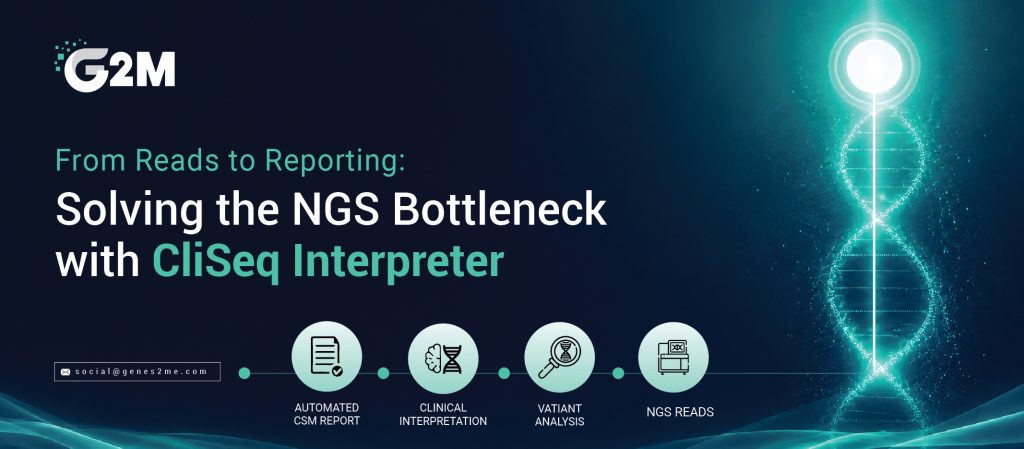
It goes deep, not just fast. Behind the scenes, it runs a full three-stage pipeline:
- Primary analysis—QC, adapter trimming, and alignment, with Q30 scores above 90% and coverage uniformity above 99%.
- Secondary analysis—Variant calling sensitive enough to catch VAFs as low as 1–5% at better than 98.9% sensitivity. SNVs, InDels, CNVs, structural variants, fusions, plus TMB, MSI, and HRD scoring.
- Tertiary analysis — the part that turns data into medicine. Variants get mapped against ClinVar, OMIM, COSMIC, and HPO, then classified under ACMG, AMP, NCCN, and ASCO guidelines, and matched to FDA-approved therapies, resistance mechanisms, and active clinical trials.
What comes out the other end is a clinician-ready Clinically Significant Mutation (CSM) Report — PDF and Excel — that a pathologist can sign and an oncologist can act on the same day.
Built to be trusted with the data that matters most
Genomic data is about as sensitive as data gets, so CliSeq runs on regional AWS infrastructure built to meet GDPR, HIPAA, and local data sovereignty requirements. For labs that need to show their work, there’s also a built-in Genewise Coverage Utility that generates gene- and location-level coverage metrics—the kind of documentation that makes audits and validations far less painful.
The part we’re genuinely proud of
Here’s where we do things differently. A lot of the industry treats interpretation software as its own profit center—tens of thousands of dollars a year in licensing, seat fees, and per-sample charges stacked on top of the assay itself. At exactly the moment labs are under pressure to move from RUO to CE-IVD workflows while reimbursement rates shrink, that math doesn’t work for anyone.
So we don’t do it that way. If your lab runs our PanCan CGP assay, our clinical exome panels, or the Hemat NGS assay, CliSeq Interpreter comes with it. No hidden fees, no per-sample tax on interpretation.
We’d rather build software that removes a barrier to precision medicine than software that becomes one.
